I am thrilled to share an important update with you as we open a new chapter in the story of United Christian Broadcasters. Since God clarified our vision through a prophetic insight in 2016, I have felt deeply moved by His calling and guided by what we now call, the ‘iSee’ vision – a vision to witness an unprecedented move of God across the UK and beyond. This vision is at the heart of everything we do at UCB, inspiring and driving me every day.
As CEO, my role over the years has grown to encompass the oversight of UCB’s work across Europe and South Africa, and it has been a privilege to serve in this expanded capacity. After much prayer and reflection together with our UCB Board, we strongly feel that within my role as CEO, it is time to focus more fully on an apostolic ministry role, sharing our broader vision and ministry and deepening our impact to our much-needed world. This shift means I will be stepping back from the daily operations of UCB to concentrate on this wider aspect of our mission.
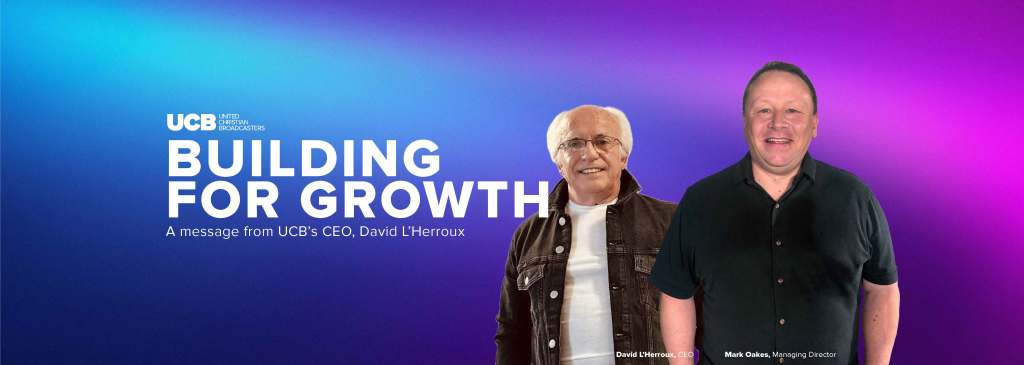
To support this transition, I am delighted to announce that, as of November the first, Mark Oakes has taken on the role of UCB’s Managing Director. Mark brings a great background to this position, with 17 years of experience as the UK Director for Christ for All Nations (CFAN). Over the three years he has been a valuable part of UCB, first as a Trustee on our Board and most recently as our Director of Communications. Mark has a true heart for revival and a deep connection to UCB’s vision, and I am confident he will lead our daily operations with wisdom, dedication, and passion.
In the coming months, Mark and I will work closely together to ensure a seamless transition, keeping UCB on course as we pursue God’s calling. I invite you to join us in prayer for Mark, his wife Kerrie, and their family, as well as for our entire UCB team, as we step into this new and exciting chapter together. Thank you for your unwavering support, your prayers, and your partnership. This new season represents a significant milestone for UCB, and I believe it will be a season of extraordinary growth and impact. Together, we are building for the future, empowered by a shared mission to bring God’s hope to a world in need
We are in a season of political change. We saw the UK begin to change last week after the election of a new Government and Prime Minister. In the US too, there is an election later this year and in my home country of France, there is also a lot of political movement and change.
I am pleased that we live in a democracy and that we each have the ability (and responsibility) to vote, but now we need to consider how we should respond to the outcome of the decisions made. How can we ensure unity in the church and keep positive relationships when our opinions can be so different? The same applies to the decisions we’re confronted with on a daily basis.
Choose who you will serve
We must remember firstly who we serve. In Joshua 24:15, Joshua commanded the people to ‘Choose you this day who you will serve.’ He told the people that the choice was up to them; it was their decision, but he ended by saying ‘As for ME and MY house, we will serve the Lord.’ Although as believers we ultimately serve the Lord, He gives us the choice and allows us to decide who we are going to serve. I believe this is a very intentional verse. It encourages us to make our choice and then have the courage and commitment to stand by what we believe.
Agree to disagree
In life we are confronted by choices on a daily basis, and the choices that we make today will affect our tomorrow.
There will always be disagreements among friends and family over the choices we make. But I believe some of these disagreements could be avoided if we tried to listen more. Too often in discussion, we are set on persuading the other person to see things as we see them, and we do not stop to listen. If we don’t listen, we won’t hear others’ views. And who knows, perhaps the opposite side might have a good point to make? If we all agreed on everything, it would be a very boring world. It is fine to say ‘I don’t see it, I don’t understand it, but I respect how you feel.’ For me, my relationships with family and friends are more precious than my argument.
Who should have the final word?
We all like to have the final word, but the final Word comes from God.
The Bible is God’s divine instruction manual, and it tells us how to live our lives according to God’s will. As I have said before, if we bought a new phone or gadget, we would always read the instruction manual so that we knew how to operate this new gift in the best possible way. The same is true of our lives and God’s Word – it tells us all we need to know about how to live a life aligned with God’s plan.
Even if we make wrong choices in life and create a mess through those choices, our failures are not fatal – provided we are willing to acknowledge them. God will always be there to help us.
Whatever situation you find yourself in today, and however you are feeling – whether it is fear or excitement – it is important to remember that God has a plan: ‘A plan to prosper you, not to harm you, a plan to give you hope and a future’ (Jeremiah 29:11).
I believe that we each have a story to tell, and I think it is important that we are ready (at any time) to tell it, both in words and in the way we live our lives.
In Mark 5, the story is told of Jesus healing the daughter of Jairus. She had been very sick, and as the daughter of a religious leader, it is likely she would have been well-known in her community. But as Jesus arrived at her home, it was too late. She had already died.
All around and inside the house were mourners, people yelling and crying about the loss of this little girl. Jesus was confronted with the reality and finality of human death. He immediately told all the mourners to leave the house, and then he took the girl’s hand and restored her back to life. And then in a puzzling verse, Jesus told the family to ‘tell no one’. It was not just a suggestion, it was a command.
In other parts of Scripture, we are told about the power of testimony, so why would Jesus command the family to keep quiet? I read this story again recently, and I believe there is a simple answer. As Jairus was the leader of the synagogue, he and his family would have been well-known and respected in the community. When Jesus arrived at their home, the house was already full of mourners, so the locals already knew that she was dead. So when Jesus brought her back to life, there was no need to tell anyone. She was a living, breathing testimony. She was the story.
Saint Francis of Assisi once said: ‘Preach the Gospel, use words if necessary.’ Many have debated this saying, but personally, I believe it means that when we have been transformed by the power of God, our lives are a walking, living testimony. We can use words to tell our story (and it is important to do so), but the words need to be backed up with evidence of a life which is changed. We can all debate words and philosophies and theology, but no one can argue with a story and a life which has been transformed.
When Jesus healed a blind man in John 9:13-25, the Pharisees questioned the man to ask how this had happened. They wanted to debate theology with him, but he simply replied: ‘I was blind, but now I see.’ Who can argue with that?!
We all have a story to share. Some may have been healed and set free or restored. For others, it may be that they were aware of God’s presence in a difficult time, but I believe we should always be ready to demonstrate and tell our story.
Here are some practical ideas:
Tell the truth
This might seem obvious, but it is important to not tamper with or change the details of the story. It can be tempting to add (or take away) details, but in doing so, we can remove all the power. Tell your story and allow God to add power to your words.
Tell your story in chapters
Imagine your life story as a book – full of different chapters. You do not have to tell the full story, but you can share different chapters at appropriate times. Depending on who I am speaking to, I use different ‘chapters’ of my testimony. Sometimes I will share the story of how I, as a rebellious young man, came to England and met God powerfully. Or I might share about the time we had no money or petrol in the car, but we prayed and God provided in a miraculous way. Or, as I have shared here, I might tell the chapter when we lost our son Jamie. You do not have to tell the whole story. The individual chapters can be just as powerful.
Some stories don’t end well
In 1988, a few weeks before we lost our son Jamie, our friends’ daughter Sarah was taken very seriously ill with meningitis. I will tell her story in a future blog post, but God stepped in and healed Sarah in a miraculous way. A few weeks later, we lost our son, and it led to many questions about why God would heal one child and yet take another. Even though our family’s story did not end the way we wanted it to, it is still a story of God’s amazing provision and faithfulness. Even if your story did not conclude the way you wanted it to, you can still tell of how God sustained you in the difficult times.
The enemy will try to stop you.
I believe the enemy knows the power of testimony. The original Hebrew root of the word ‘testimony’ means to ‘do it again’. In other words, when we share our testimony, we are literally encouraging others to believe that God CAN ‘do it again’. The enemy will try to quench the power of stories, and he will try to stop you from sharing yours, but when you tell your story, you are saying to the world ‘God is alive and He is at work in my life.’ There is huge power in that.
I believe that God wants to ‘do it again’. Do you have a story to share? Why don’t you start to tell it?
p.s UCB has recently produced Power of the story – a brand new book with 30 testimonies of lives that have been changed for good by the power of God’s Word. You can get a *free copy at www.ucb.co.uk/storybook (*P&P applies)
In February 1988, our lives as a family were going well. We had three beautiful children, and I was moving up the ladder in my career with a retail chain.
Our beautiful three children
I have always been an early bird, and my morning routine before leaving for work was to check on our youngest son Jamie, who was 13 months old. On the morning of February 9, I left for work but for some reason that day, I did not check on him. I arrived at work and just after 9am, I received an urgent phone call from a neighbour who said, ‘something has happened to Jamie, you need to come home.’
The details were not clear at that point, so I jumped into the car and drove home like I have never driven before. As I was racing along, the word ‘death’ kept coming into my head, and I screamed out to the Lord, ‘No, Lord… no, this CANNOT be true.’
JamieJamie
As I arrived at home, the front door was open, the paramedics were working on Jamie, and I could hear the desperate cries of my wife. I still did not know what was going on, but I learned that our son Richard, who was 10, had found his brother unresponsive in his bed. The paramedics took Jamie to hospital, blue lights and sirens blazing, and my wife and I followed behind in the car. When we arrived at Casualty, we were met by the doctor and were not allowed to see Jamie while they worked on him. Eventually a doctor came out and we could see by the look on his face that it was not good news. Our beautiful son had died at 13 months old from sudden infant death syndrome.
We were numb, confused, angry and had many questions. Jamie had been for a routine check-up just a few weeks earlier and was fine. Had we done something wrong? Could this have been stopped? It felt as though we were trapped in a nightmare and we struggled to understand.
The hospital staff eventually told us that Jamie’s body was in the Chapel of Rest and asked if we wanted to see him. My wife did not feel able to go, so I went to spend some time there on my own. As I stood there, my heart cried and ached, and I said, ‘God, I KNOW you can do this, I know you can bring him back.’ As I prayed, I suddenly felt a strange tap on my shoulder. I immediately looked around, but no one was there. This happened three times, and each time, there was no one behind me. But then very clearly, I felt God speak into my spirit. I cannot say for sure if it was an audible voice, but I know God spoke:
‘He will not come back to you, but you will go to him one day.’
I learned years later that these were words spoken by King David in 2 Samuel 12:23 after he lost his own infant son. Although I did not recognise at the time where the words came from, I knew God was saying there was nothing more we could do. He had taken Jamie home. In one sense, it released me from the burden of praying for God to restore Jamie to us, but that did not stop us from feeling the desperate agony of grief.
In the days ahead, although our lives were shattered, we tried to keep things as normal as we could for our children, Richard and Natalie. Our church family gathered around us, and our pastor, John Mosey, was a wonderful friend, supporting us through the many practical arrangements we had to make. Little did we know that John would face his own terrible family tragedy toward the end of the year, but I will talk more about that in another blog post. The church’s support was incredible, but we still had so many questions. I felt God speak to me clearly one day: Stop asking me why. Ask me what I am going to do through it.
Two weeks later, I had been due to speak at our church. Our pastor said I did not have to do it, but I was able to share a short word on Romans 8:31: ‘If God is for us, who can be against us.’ I asked our church family to pray for us, and I also encouraged them to be as normal as they could with us. We didn’t want people to stay away or think that we did not want to see their children or their babies. We knew this would be an important part of rebuilding our lives.
Throughout all that time, I can say that I felt God was lifting me. I had to grieve, but I also had the responsibility of caring for my wife and children too. My mother gave me a copy of the famous Footprints poem, and I knew that despite our shock and grief, God was carrying us through the darkest time of our lives.
Today as a family, we live and enjoy a good life. It is a different life which will always be scarred by losing Jamie, but we are not broken. We have been through many stages of grief, and up until recently, I was struggling with many private emotions. In a future blog post, I will share more on this and how I feel God has set me free from the burden of guilt which I carried for many years.
If you are facing your own tragedy today, then if you are a believer, you can know that God is with you and will carry you through it. As believers, we are not protected from pain, and we should not con ourselves and think we can go through this life without heartache. But God can hold us together powerfully through the most terrible times of our lives and give us strength to keep going.
After a terrible loss, your life may never be the same again, but with God, it can still be a good life. He is the reason for our hope, and we know that one day we will see Jamie again.
It’s Fathers’ Day this weekend and I have been reflecting on the story of the Prodigal Son.
In Luke 15, it says the son, although living in a wealthy home, decided to break free from the family he had been raised with. He wanted his inheritance early so he could explore the world for himself.
He went to his father and asked for what was owed to him, not realising that by exploring the world on his own, he was removing himself from his foundation, from the source of everything that was good in his life.
Over time, the son ran out of money and found himself WANTING TO EAT pig food to survive. However, despite making a terrible mess of his life, he was still the son of a very wealthy man. He had walked away and made very bad choices, but his father still loved him.
The son decided to go home and ask if he could be a servant in his father’s home to repay his debt. However, God’s Word tells us that when the father saw his son, he ran to him and embraced him. You see, no matter what the son had done, he was still a son. No matter what he did, he would always be the son of a very influential man.
We can take many thoughts from this story, but I started to think about the nature of fatherhood and how we can rely on our Heavenly Father, no matter what we go through in life.
I am a father and a grandfather, and as a dad, I am part of the foundation of my family. It is my job to bear the burdens and responsibilities of my family as well as enjoy the many blessings. Some years ago, I wrote an acrostic of the word ‘Father’, which has helped to remind me of what a Father looks like and what our Heavenly Father longs to do for us.
Our Father is…
Faithful: ‘It is because of the Lord’s mercies that we are not consumed, because his compassions fail not. They are new every morning: great is thy faithfulness.’ (Lamentations 3:23)
Although grown up with families of their own, my kids expect me to be faithful. I am committed to being faithful to them and our family, and in the same way, we can trust God to be faithful to us. Just like the story of the prodigal son, He is faithful to us, even when we are not faithful to Him.
Able: ‘Now unto him that is able to do exceeding abundantly above all that we ask or think, according to the power that works in us’. (Ephesians 3:20)
When my children were younger, I was aware that they hung on to every word I said. It is the same with our Heavenly Father; we can hang on to every word He says because He is able to do more than we can ever imagine or think.
Trustworthy: ‘No, I will not break my covenant; I will not take back a single word I said.’ (Psalms 89:34)
In the same way that my children expected me to be faithful, they knew also that I was trustworthy. Although I did not always get things right, they could always trust me. It is the same with God – we CAN trust Him.
Hope in Hopelessness: ‘Those who hope in the Lord will renew their strength. They will soar on wings like eagles.’ (Isaiah 40:31)
Even after the death of our son, Jamie, we discovered that God gave us hope in the middle of a hopeless situation. We don’t always get the good outcome that we hope for, but even in a very broken world, there is still hope. This is the hope our Father gives us – He came to die for us to give us the gift of hope.
Everlasting: ‘…I have loved thee with an everlasting love; therefore, with loving kindness have I drawn thee.’ (Jeremiah 31:3)
God is also everlasting, and His presence is with us wherever we go and whatever we do. As an earthly father, I love my kids with every cell of my being, and over the years, I have worked hard to provide for them. As I have grown older, I have realised that the most precious gift I could give them was my presence – not any fancy gadget. God’s love for us is everlasting, and He wants us to be and live in His presence.
Reliable/Relevant: ‘…for He has said, I will never leave you, nor forsake you.’ (Heb 13:5); ‘The LORD watches over you — the LORD is your shade at your right hand.’ (Psalms 121:5)
As a dad, when my children were younger, I would often get up in the night to check on them. If they were uncovered, I would pull the blankets up and make sure they were sleeping peacefully. The Word says that God watches over us, but (unlike a human father), He never slumbers or sleeps. He is reliable and relevant in every situation.
That is what a picture of our Heavenly Father looks like, and it is a great picture to cling to.
But what if you did not have a good father? I am blessed because my father was a wonderful dad and a Godly man, but for those who did not have that experience, this is where you can learn to love your heavenly Father.
He is the Father to the fatherless! Humans and earthly dads can let us down, but the Creator of the universe calls himself ‘Abba’ meaning ‘Daddy’. We can go to Him at any time; He is our sustainer and He can lift our heads high with hope. He knows when we feel alone or unloved, and even in death, He remains the resurrection and the life.
Even if your experience of fatherhood has been flawed, there is a great, heavenly Father who will always care for us, no matter what we go through.
He is the perfect example of Fatherhood, and He is available to us all.
Over the past few weeks, I have been deeply shocked and saddened to read the reports about the late apologist Ravi Zacharias. As a broadcasting ministry (both here in the UK and with many of our affiliates across the world), we aired teaching from Ravi Zacharias for some years. In the UK, we stopped broadcasting these teaching programmes in 2015 (due to a change in focus for our radio stations) but when Ravi Zacharias died in 2020, we paid tribute to his life (as we knew it) on UCB Radio and on Social Media.
Today, as more about his life and unconscionable actions are revealed, our hearts ache for the devastation and pain this has caused both to the victims and to the many people who will also feel hurt and confusion to read of these terrible events. We continue to pray that God will bring the kind of restoration and healing that only He can bring.
These events have reminded me personally of how much we need God’s grace and wisdom in our lives as leaders. The enemy’s strategy has always been focused on three main areas: to steal, kill and destroy. This is why Paul reminds us of the importance of putting on the full armour of God – ‘For we do not wrestle against flesh and blood, but against principalities, against powers, against the rulers of the darkness of this age, against spiritual hosts of wickedness in the heavenly places.’
However, although we do wage war against an unseen enemy, this in no way belittles sin. Sin is sin, and whether we like it or not, all sin has consequences. I am reminded of the story of David and Bathsheba. David not only committed adultery with another man’s wife, he sought to cover up his sin by murdering Bathsheba’s husband. Although it is very clear in Psalm 51 that David was repentant, he still had to pay the consequences for his actions.
So as believers (and leaders), how should we respond when we hear reports like these?
1. Firstly, I believe that those who are confused and hurting should be our priority. If we do not know them personally, we can pray for them (God knows their names) and we can ask God to bring transformation, healing, and restoration.
2. We can use reports like these as a ‘check up’ for our own ministries. Are we as accountable as we should be? Do we have proper structures in place to prevent misuse of power and misdeeds? If not, if you are a leader, can I encourage you today to put these structures into place. A crucial (practical) part of putting on our armour is to ensure that there are processes in place to hold ourselves accountable
3. If we have sinned, we have a duty to confess this and put the matter right. We may even have to pay the consequences through loss of a job or status or in some cases, even the loss of family (as King David did) but we must also know that when we are truly repentant, God’s grace has capacity to forgive us. Our lives may never be the same again, but we can know that in the sight of God, we have been forgiven.
In conclusion, let me encourage you as leaders to be very aware of what God has entrusted us with. He has entrusted us with the power to influence for good, and to do that well, we must understand the full weight of this responsibility and make ourselves accountable, first to God but also to some good and trusted people.
And if you are on the other side of the coin and have been the victim of someone else’s terrible actions and have been hurt or damaged, I want to remind you that God is a healer not just of our physical needs but our emotional and spiritual wounds too. He has not changed and is still in the business today of restoring broken lives. With the right support from good and trusted friends, prayer and counselling, God can once again restore ‘fullness of life’ to you, so that one day you too will be able to be a positive influence in the lives of others.
If you have been hurt by this or other actions, can I encourage you to share this hurt with someone. You could reach out to UCB’s Prayerline, and the team there will pray for you and can point you to organisations which can offer help. You can contact them through our website at www.ucb.co.uk/pray
After all we have been through in 2020, I think it is impossible to still be the same! I don’t know about you, but I want to take as much as I can from all that happened last year and allow God to use it for good.
Just before Christmas, I was reading Matthew 2:11, which tells the story of the birth of Jesus. We are told that the wise men ‘departed into their own country another way’. In other words, their plans changed and they went home a different route to the one they had planned.
The wise men travelled miles to see Jesus the King of the Jews, and when they found Him, they responded with joy, sincere worship, and abundant gifts. To be honest, it was quite different from the way many people approach God today! Many people tend to expect God to come looking for them, prove Himself to them, and give them gifts. However, we are told that after the wise men found Jesus and worshipped Him, they went home another way. What does that mean to us today?
1. When you encounter Jesus in your life, you can never be the same again
Having an encounter with Jesus means our life has to take a different direction, and just as the wise men (after being in the presence of the Living God) were changed, so must we be changed too. After the unprecedented experience of the last twelve months, I do not believe that we can move into 2021 the same way that we entered 2020.
As I look through God’s Word, I am amazed to read story after story of people who experienced an encounter with the Almighty God and could not ‘return home’ the same way. Their lives were turned upside down and their direction changed.
Let’s look at a few examples of people ‘going home another way’.
Mark 5:1-20 — The demon possessed man
No man could bind or tame him; he had a legion of demons and was running wildly in a totally possessed state. And then after meeting Jesus, he was totally set free, clothed and in his right mind to the point that he begged Jesus to be able to travel with him. Jesus said: ‘Go home to your friends and tell them the great things the Lord’s done.’
Let me tell you: he definitely went home ‘another way’ – joyful, dancing, praising God, and telling many what Jesus had done for him.
John 8:3-11 -The woman caught in the act of adultery
By law she shouldn’t have gone home at all (never mind another way). She should have been stoned to death. But as she encountered Jesus, He said to her: ‘Go and sin no more.’ And she went home another way!
Luke 19:1-10 – Zacchaeus
Jesus stood still, lifted his eyes, and called Zacchaeus down from the tree: ‘Zacchaeus, quickly come down; for this very day I must stay in your house.’ Jesus knew the mess that Zacchaeus‘ house was in! And Scripture tells us that ‘Zacchaeus stood, and said unto the Lord, “behold Lord, half of my goods I give to the poor and if I have taken anything from any man by false accusation, I restore him fourfold.”‘ Jesus said: ‘This day salvation comes to this house.’ He went home not only by another way but with Jesus. How awesome is that!
All those who met with Jesus, all went home different than they came: the woman with the issue of blood, Blind Bartimaeus, the man at the gate called ‘Beautiful’, the crowds on the day of Pentecost. I tell you that even those in the upper room – they all went home different than the way they came: full of the Holy Ghost and totally transformed.
I believe we will discover in this new year that many are entering 2021 totally transformed because of what they have experienced in 2020. But at the same time, we also have to be aware of the enemy’s strategy to ‘steal, kill and destroy’ if we do not take heed of God’s instructions.
Matthew 2 tells us: ‘So the wise men decided not to go back to Herod as he’d commanded them, but to go home by another way…’ Herod’s intention was to find Jesus – he certainly didn’t plan to worship Jesus as king but rather to kill him and destroy all what he stood for. In this there are warnings for all of us:
1. Not everyone is going to embrace your visions and dreams, hence it is wise sometimes to keep them to yourself to prevent the enemy from killing what God has given you.
2. Remember that the enemy hates your experience of transformation and will tempt you in every way for you to return home ‘the same way’ and deny what God has done for you.
3. Be sensitive to the voice of the Divine Shepherd, for His instruction is for your good: to protect you from the wiles of the enemy.
Don’t ever forget that just as God dealt with Herod – who set out to destroy Jesus and everything that He stood for over 2 thousand years ago – God dealt with Satan, who then too tried to kill him. Praise God that Jesus arose on the third day triumphant and glorious that you and I might be victorious too!
And because of this victory and this transformation experience, we can enter this New Year full of joy, full of worship, ready to fulfil the assignment that we have been given for His glory. Therefore today make sure that ‘YOU GO HOME ANOTHER WAY!’
Today, I saw this headline: ‘This is the third terrorist attack France has suffered in just over a month.’ My heart sank, and as always in the face of such terror, I wondered ‘How should I pray about this?’
As many of you will have read, France (my home country) has been hit by 3 attacks recently, and as Christians, in the face of such suffering and evil, it can be difficult to know exactly how to pray.
Today I am again reminded of the words of Psalm 37:
‘Do not fret because of those who are evil or be envious of those who do wrong. Be still before the Lord and wait patiently for him; do not fret when people succeed in their ways, when they carry out their wicked schemes. The salvation of the righteous comes from the Lord; he is their stronghold in time of trouble. The Lord helps them and delivers them; he delivers them from the wicked and saves them, because they take refuge in him.’
So, in the light of Psalm 37, how can we pray?
Firstly, let’s consider people. Let’s pray for those who are fighting for their lives. Let’s pray for the families and those who have lost someone they loved. Let’s also pray for those who witnessed the attack and for the local residents who have to come to terms with this enormous tragedy. Let’s pray also for the medical centres who are working with the injured.
Secondly, we need to pray for wisdom for national governments as they discuss and debate what happens next, that they choose ways and responses which are inspired by God and not necessarily their own intuition.
Thirdly, let us always go to God’s Word for our answers. His Word (John 1:5) says that the darkness in the world will get darker, but that darkness will never extinguish light. In fact, it says that light (His light) will continue to shine brighter and the darkness CANNOT overcome it. That is where I get my strength and hope.
Let’s pray with passion for our world and all those who are suffering and grieving today.
And may God’s light, His in-extinguishable light, shine ever brighter in the middle of the darkness we see.
In an earlier blog, I shared some thoughts about lessons I have been learning from the story of Moses in Exodus 15.
Moses had led the people of Israel out of Egypt, but their journey wasn’t smooth and had many, many difficulties. The people had recently seen God do a great miracle by turning the bitter water of Marah into water they could drink, and now they were about to receive an even greater blessing.
In Exodus 15 verse 27, it says: ‘Then they came to Elim, where there were twelve wells of water and seventy palm trees; so they camped there by the waters.’
I love how these verses point to a God who is ‘more than enough.’ He had already supplied drinking water for them, but now He led them to an oasis which was an extra, unexpected blessing. It was waiting around the corner, just for them!
As we find ourselves in this continuing, unprecedented, bitter storm which is affecting not just us but the whole world, this verse comes back to mind: ‘The righteous shall flourish like a palm tree.’
Did you know that palm trees are designed to withstand severe tropical storms? When the storm comes, they don’t break, but instead they bend with the wind and heavy rain. It looks as though they are breaking, but they are actually just adapting to the wind. When the storm passes, the area where the palm tree has almost been torn in two is actually stronger than it was before the storm.
During this prolonged difficult time that we are all going through, I feel God reminding us that we are like a palm tree in the storm of life. When this is over, we are going to fall right back into shape, but we will also be stronger and able to flourish more than ever before.
As believers, let us never forget that the Prince of Peace lives within us. We can look at our bitter storm and easily forget that He who is in us is greater than the circumstances that we are in.
As we are facing this raging bitter storm at the moment, I want to encourage you to trust in God’s Word. He promises to be with us always, and He is our Rock, even in the middle of the fiercest trials.
Above all, Jesus said: ‘And everything I’ve taught you is so that the peace which is in me will be in you and will give you great confidence as you rest in me. For in this unbelieving world you will experience trouble and sorrows, but you must be courageous, for I have conquered the world!’ (John 16:33 TPT).
And then in Isaiah, we are reminded: ‘When you pass through the deep, stormy sea, you can count on me to be there with you. When you pass through raging rivers, You will not drown…’ (Isaiah 43:2 TPT).
Let us hang on to the truths and wisdom found in God’s Word – He will never fail us.
In a previous blog, ‘How to turn a crisis into a testimony’, I wrote about the people of Israel and how they quickly turned from rejoicing to murmuring when they hit difficult times.
As I have been continuing to look at Exodus 15, I have been reminded that in the middle of a crisis, our response to what is happening is very important. As Moses faced the people, who were angry and irritable because of the lack of water, I love his response. He could have sought to justify himself, but instead he did not reply. In verse 25, it says that his first response was to go to the Lord to intercede on behalf of the people. And guess what: it says ‘The Lord showed him a tree’. And as Moses threw a branch into the water ‘the waters were made sweet.’
As I studied these verses, several things came to mind.
A tree does not grow overnight
Any gardener knows just how long trees take to grow – many, many years. God used a tree to bring help to the people of Israel, which means that God created an answer long before there was even a problem. And I believe He has done that for us too. Whatever bitter waters we find ourselves in today, God has already gone ahead of us, making sure that the answer is there and ready just when we face our most bitter crisis.
The answer was right there
In this particular situation, the answer was right there in front of their eyes, but they could not see it! In my experience, I have learned that often God’s answers are so close, and yet we can fail to see them. This is just like the widow with the small jug of oil in 2 Kings 6: the answer to her problem was there in her own house already, but she needed the prophet Elisha to reveal it to her. Can I encourage you that if you know the Lord as your personal saviour, then the answer to your situation is hidden within you, just as the same spirit that rose Christ from the dead also lives in you.
A miracle tree
In this story, God used a tree to make bitter waters sweet, but that tree also reminds me of the tree that Jesus died on over 2000 years ago. God threw his beloved son on to a tree to take the bitter sin of humanity so that anyone who believes in him would be able to discover the sweetness of life. You see, through Jesus we can not only have life, but we can experience abundant life.
Whatever situation you find yourself in today, whether it is the stress caused by the global situation or you are facing your own private ‘bitter waters’, I would like to encourage you that the answer to your problems lies in Jesus Christ, who also lives in you. You might say ‘David, I don’t know what to do or where to turn.’ Well, my advice is to at least call on his name. He promises us this in Psalm 50: ‘Call upon Me in the day of trouble; I will deliver you, and you shall glorify Me.’
He who never changes is able to bring peace to your bitter storm. Try it and see what happens.









 David L'Herroux