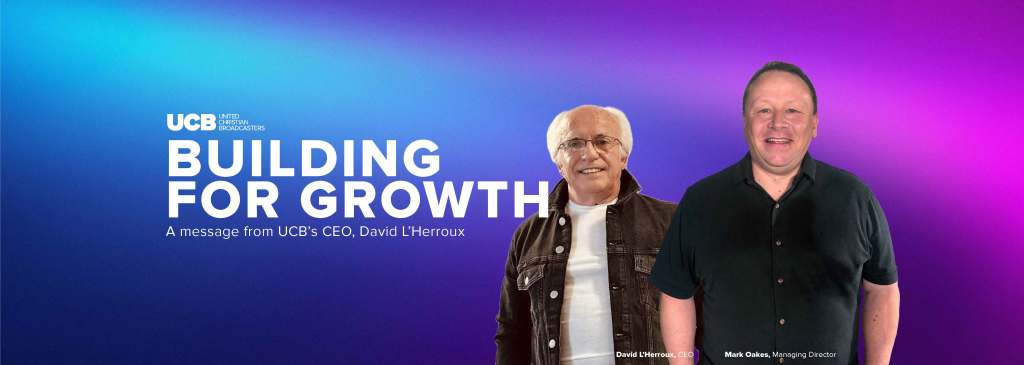
I am thrilled to share an important update with you as we open a new chapter in the story of United Christian Broadcasters. Since God clarified our vision through a prophetic insight in 2016, I have felt deeply moved by His calling and guided by what we now call, the ‘iSee’ vision – a vision to witness an unprecedented move of God across the UK and beyond. This vision is at the heart of everything we do at UCB, inspiring and driving me every day.
As CEO, my role over the years has grown to encompass the oversight of UCB’s work across Europe and South Africa, and it has been a privilege to serve in this expanded capacity. After much prayer and reflection together with our UCB Board, we strongly feel that within my role as CEO, it is time to focus more fully on an apostolic ministry role, sharing our broader vision and ministry and deepening our impact to our much-needed world. This shift means I will be stepping back from the daily operations of UCB to concentrate on this wider aspect of our mission.
To support this transition, I am delighted to announce that, as of November the first, Mark Oakes has taken on the role of UCB’s Managing Director. Mark brings a great background to this position, with 17 years of experience as the UK Director for Christ for All Nations (CFAN). Over the three years he has been a valuable part of UCB, first as a Trustee on our Board and most recently as our Director of Communications. Mark has a true heart for revival and a deep connection to UCB’s vision, and I am confident he will lead our daily operations with wisdom, dedication, and passion.
In the coming months, Mark and I will work closely together to ensure a seamless transition, keeping UCB on course as we pursue God’s calling. I invite you to join us in prayer for Mark, his wife Kerrie, and their family, as well as for our entire UCB team, as we step into this new and exciting chapter together. Thank you for your unwavering support, your prayers, and your partnership. This new season represents a significant milestone for UCB, and I believe it will be a season of extraordinary growth and impact. Together, we are building for the future, empowered by a shared mission to bring God’s hope to a world in need
In February 1988, our lives as a family were going well. We had three beautiful children, and I was moving up the ladder in my career with a retail chain.
Our beautiful three children
I have always been an early bird, and my morning routine before leaving for work was to check on our youngest son Jamie, who was 13 months old. On the morning of February 9, I left for work but for some reason that day, I did not check on him. I arrived at work and just after 9am, I received an urgent phone call from a neighbour who said, ‘something has happened to Jamie, you need to come home.’
The details were not clear at that point, so I jumped into the car and drove home like I have never driven before. As I was racing along, the word ‘death’ kept coming into my head, and I screamed out to the Lord, ‘No, Lord… no, this CANNOT be true.’
JamieJamie
As I arrived at home, the front door was open, the paramedics were working on Jamie, and I could hear the desperate cries of my wife. I still did not know what was going on, but I learned that our son Richard, who was 10, had found his brother unresponsive in his bed. The paramedics took Jamie to hospital, blue lights and sirens blazing, and my wife and I followed behind in the car. When we arrived at Casualty, we were met by the doctor and were not allowed to see Jamie while they worked on him. Eventually a doctor came out and we could see by the look on his face that it was not good news. Our beautiful son had died at 13 months old from sudden infant death syndrome.
We were numb, confused, angry and had many questions. Jamie had been for a routine check-up just a few weeks earlier and was fine. Had we done something wrong? Could this have been stopped? It felt as though we were trapped in a nightmare and we struggled to understand.
The hospital staff eventually told us that Jamie’s body was in the Chapel of Rest and asked if we wanted to see him. My wife did not feel able to go, so I went to spend some time there on my own. As I stood there, my heart cried and ached, and I said, ‘God, I KNOW you can do this, I know you can bring him back.’ As I prayed, I suddenly felt a strange tap on my shoulder. I immediately looked around, but no one was there. This happened three times, and each time, there was no one behind me. But then very clearly, I felt God speak into my spirit. I cannot say for sure if it was an audible voice, but I know God spoke:
‘He will not come back to you, but you will go to him one day.’
I learned years later that these were words spoken by King David in 2 Samuel 12:23 after he lost his own infant son. Although I did not recognise at the time where the words came from, I knew God was saying there was nothing more we could do. He had taken Jamie home. In one sense, it released me from the burden of praying for God to restore Jamie to us, but that did not stop us from feeling the desperate agony of grief.
In the days ahead, although our lives were shattered, we tried to keep things as normal as we could for our children, Richard and Natalie. Our church family gathered around us, and our pastor, John Mosey, was a wonderful friend, supporting us through the many practical arrangements we had to make. Little did we know that John would face his own terrible family tragedy toward the end of the year, but I will talk more about that in another blog post. The church’s support was incredible, but we still had so many questions. I felt God speak to me clearly one day: Stop asking me why. Ask me what I am going to do through it.
Two weeks later, I had been due to speak at our church. Our pastor said I did not have to do it, but I was able to share a short word on Romans 8:31: ‘If God is for us, who can be against us.’ I asked our church family to pray for us, and I also encouraged them to be as normal as they could with us. We didn’t want people to stay away or think that we did not want to see their children or their babies. We knew this would be an important part of rebuilding our lives.
Throughout all that time, I can say that I felt God was lifting me. I had to grieve, but I also had the responsibility of caring for my wife and children too. My mother gave me a copy of the famous Footprints poem, and I knew that despite our shock and grief, God was carrying us through the darkest time of our lives.
Today as a family, we live and enjoy a good life. It is a different life which will always be scarred by losing Jamie, but we are not broken. We have been through many stages of grief, and up until recently, I was struggling with many private emotions. In a future blog post, I will share more on this and how I feel God has set me free from the burden of guilt which I carried for many years.
If you are facing your own tragedy today, then if you are a believer, you can know that God is with you and will carry you through it. As believers, we are not protected from pain, and we should not con ourselves and think we can go through this life without heartache. But God can hold us together powerfully through the most terrible times of our lives and give us strength to keep going.
After a terrible loss, your life may never be the same again, but with God, it can still be a good life. He is the reason for our hope, and we know that one day we will see Jamie again.
In December 2013, I attended the funeral of a dear lady who was 99 years old. She had served God faithfully in the church (which my brother pastors in France), and for many years, her heart’s desire was to see a revival. In almost every meeting, her voice could be heard: ‘Lord, send yet again, a revival!’
I had the privilege of attending her funeral, and it was a truly remarkable occasion where the presence of God was felt so powerfully. My brother Daniel said to me ‘You need to preach in church on Sunday’, and the following weekend, which was the last Sunday of 2013, as I spoke, we began to see and feel the expectation level in the church rising up in an unprecedented way. This led to the beginning of a mighty move of God, and over the next few years, this move of God would lead to many people becoming saved and experiencing healing.
Sometimes I look back and wonder if the funeral of our dear 99-year-old friend was actually the spark that lit a flame. Although she did not live to see it, her faithful prayers over the years led to a new move of God.
I have been thinking about this recently as I have been closely watching world events.
All around us, large churches, which have seen 1000s of members walk through their doors each week, have had to go ‘back to basics’ and meet in small, sometimes online groups. Throughout the Covid crisis, we have been forced to look at how we do things smaller, rather than how we make them bigger.
And we are learning how to not despise ‘small beginnings’.
Just like our 99-year-old friend in the church, her prayer life may have seemed ‘small’ to some, but I believe her faithfulness (even to the end of her life) led to something very big being ignited.
Please don’t get me wrong. I love to see churches filled with many members, but I also believe that there is Biblical precedent for small gatherings too.
In Mark 5, Jesus goes to the home of Jairus to pray for Jairus’ daughter who was very sick. When Jesus arrived there, the Scripture tells us that there were many people present, many of whom were crying loudly and wailing. And Jesus quickly sent them out of the house so that there were just a few left.
It was in that very ‘small’ moment that an incredible miracle occurred, and the little girl, who by this point was dead, was now brought back to life. Often times, we can devalue and overlook what is seemingly little.
As Coronavirus has impacted churches all across the world and forced them back to ‘small beginnings’, it would be easy to see this as a setback, but what if this is a divine strategy to usher in a move of God like we have never seen before?
Matthew 18:20 says ‘Where 2 or 3 are gathered in my name, there I will be with them.’
The presence of God is just as powerful and real in a small gathering as He is present in a large gathering.
Even here at UCB, our wider team (of more than 100 staff and volunteers) is not able to meet together in person, but I am hearing stories of UCB teams meeting together online, sharing Bible studies, praying for each other in new ways.
I firmly believe that for us as an organisation, we will not be ‘returning to normal’. This pandemic is forcing us to think in new ways and to not ‘despise small beginnings’.
Throughout history, God has used small groups of people to ignite something big. From the disciples (just a group of 12 men) to people like my praying friend, small groups of faithful people have been powerfully used by God to usher in great moves of the Spirit.
If you are part of something ‘small’ today, can I encourage you to have a bigger vision for it? By embracing something small and allowing God to use it, you could be part of ushering in a new move of God.
I have been thinking this week about the story of Mary.
Mary, the mother of Jesus, was given an extraordinary assignment, and if you have a dream and a vision for the future, her life story is a great encouragement.
Your past doesn’t matter
God gave Mary a special job, despite the fact that by human standards, she was too poor, too young and from the wrong part of town. God could have gone to the palaces to find a ‘suitable’ mother for the Messiah, but instead He chose an unknown girl from a poor village. To me, this is a reminder that our past, our background, or our culture is not a problem for God. When I arrived in the UK, I was a young foreigner, but God took hold of me and changed my life in unexpected ways. We are all born with a God-given purpose, and God loves to take insignificant people (in the world’s eyes) and birth significance into their lives.
A vision for the future can make you feel hopeless
This might seem like a strange thing to say, but often when God gives us a dream, we can feel hopeless. How will God accomplish such a thing? Is it possible? Have I imagined this? And yet, just like Mary, when God speaks to us and gives us a vision, His Holy Spirit can empower us, take us further than we could ever imagine, and make the impossible possible in our lives.
His Holy Spirit is bigger than our intellect, our talent and our ability. His Holy Spirit is bigger than our past, our culture, and our logic. But like Mary, we have to stop arguing with our reason and thinking and instead say ‘God, if you said it, I will align my will to your will.’
You have to step up
With any vision, talking about it or thinking about it won’t make it happen. When Gabriel visited Mary after the initial shock, she got up and went to visit Elisabeth. That was her response. And likewise with us, we have to form a response and begin to move forward into what God has called us to do. We might not immediately see results, but it is important to live in a culture which cultivates it. Surround yourself with people who will speak life into your vision, and like Mary, rub shoulders with people who will make that dream ‘leap’ within your spirit.
Be patient
Mary had to wait 9 months to see the fulfilment of the vision God had given her. You and I may have to wait much longer. The process of waiting for the dream to come true can be a time of real preparation.
Here at UCB, we believe God has given us a vision for an unprecedented move of God which will sweep the UK and beyond. We haven’t yet seen this (although we believe we are seeing small signs), so instead, we are preparing ourselves, our infrastructure, and our organisation to be ready for when it happens and so that we are able to support the Church 24/7, 365 days a year. Mary had to prayerfully get ready for the arrival of Jesus. She knew what was promised would come true, and so she began to prepare for what she knew was to come.
Don’t despise small beginnings
The arrival of Jesus was a low-key affair. There was no room at the inn for the newborn king. There was no fanfare from the palaces. There was no state announcement. In fact, if it were not for the angels who sang and the light of a star, His birth may have gone unnoticed for a long time. Jesus himself was placed in a feeding manger in rags: the most unassuming, ‘small’ beginning for the Saviour of the world. And yet, those small, humble beginnings led to the plan of salvation for all of mankind.
It’s important to remember that great things (just like oak trees) can have the smallest and most humble of beginnings.
Can I encourage you today that if you are waiting for God to fulfil your own vision and dream, be faithful to what you believe God has shown you. Use the time positively to prepare spiritually (and physically), and surround yourself with people who will help to keep you accountable.
My family and I spent our Summer holiday in the Loire Valley, an area famous for its vineyards and wine making. During my time there, I started to think about the journey of the grape and the long process it goes through from vine to wine glass. I felt God challenge me about that journey and how it could apply to the long process we each go through in life to become who God would have us to be.
If I was to imagine myself as a grape, this is what the process might feel like:
It is a fresh sunny day in early spring, and I am hanging on the vine with a bunch of others, covered with morning dew. I feel like I am part of something, and life’s prospects seem good, but then suddenly, the rain and hail hits.
I try to hide behind the vine leaf to shelter from the storm, but it is hard to keep dry, for the vine has been pruned back, and I am now exposed, unable to hide.
Where has the sun gone? Is this Spring or Winter? No one told me this would be so hard! It feels like hell. Surely this will be over soon?
And then after a turbulent and stormy and wet Summer, now Autumn has come. Early morning early frost settles on the vine, and again I found myself wanting to shelter, but then before I know it, it is harvest time, and suddenly, I am being picked from the vine.
There are loud engines and machines all around, and I find myself being ripped from all that is secure and safe.
I am put into a large, dark, smelly container and then turned into another metal large box, where I am being pressed and squeezed. My very shape itself is being moulded into something else, and all I can feel is intense pressure and deep, deep crushing. It hurts!
Finally, just when I think it is over, I am then poured into a wood barrel and wheeled into a dark cellar. Surely this is it? All this crushing, this pain, this change… surely I am now ready and finished? This must be the final stage which will last a few hours, no?
But no, this process takes a few years, and then something remarkable happens. Suddenly, a light shines into the darkness, and the wine is being tasted. ‘It is ready’, I hear the voices cry as they pour me into a much smaller container, a bottle.
There’s a label on the outside of the bottle to describe what I now am, but just when I think I am about to be released into my purpose, I am once again now laid carefully on a shelf to wait and wait and wait.
It seems as though the waiting goes on forever, but then once again, the light shines into the darkness, and I am being gently handled. The cork on the bottle is carefully removed, and I am being poured into a large glass. I can hear all the voices around the table, and I can hear the host of the party, saying ‘Try this fine wine… this is the best I have ever made.’
Everyone is smelling and swirling and tasting and agreeing with the host that this long process has been worth it all. All the seasons, all the crushing, the pressing, and the waiting has produced something that not only looks beautiful but which also smells and tastes wonderful.
If we apply the picture of a grape to our own lives, I am sure we will see many similarities.
We each walk through many seasons, many of them very painful, which at times feel as though they will never end.
And yet, through the whole process, God is making something beautiful and precious out of everything we go through.
What season are you in today? And if you were squeezed, what aroma, what taste would come from you? My prayer is that we can stand with Paul, who said ‘But I will rejoice even if my life is poured out like a liquid offering to God, over your sacrificial and surrendered lives of faith.And so no matter what happens to me, you should rejoice in ecstatic celebration with me!’ (Philippians 2:17).
I pray that whatever season you are in, you will believe and be encouraged that no matter what is happening, God can use this time to make something beautiful out of us.
I first met Bernard Hibbs when he and his wife came to UCB to be interviewed for a programme on UCB 1. Some time later, myself and the Chairman of UCB’s Board, Alan Scotland, went to visit Bernard and the Bruderhof community in East Sussex. We toured the site, ate with the community, attended a meeting, and heard about their deep expression of faith. It was a fascinating day.
This week, there will be a documentary on BBC 1 (Inside the Bruderhof) and in anticipation of that, I asked Bernard to write a guest blog to share more about what the community believes and what everyday life is like. I hope you will enjoy reading more about this simple but remarkable way of life.
David L’Herroux
Bernard writes…
I have always been fascinated by the verses in Acts 2 and Acts 4 that describe the first church. ‘All the believers were together and had everything in common’ and ‘All the believers were one in heart and mind. No one claimed that any of their possessions were their own, but they shared everything they had.’
Why would these first disciples suddenly depart so abruptly from the norm of looking after yourself and your family first, and voluntarily engage in sacrificial sharing with the needy?
It doesn’t take a lot of time looking through Jesus’ teachings to realise that the answer is actually quite clear: he told his disciples to leave their nets and follow him; he told them to not worry about food or clothes; he said that they would not be able to serve God and mammon; he praised the widow who gave everything; he told a rich ruler to give everything he had to the poor and to follow him; he said that to love our neighbour was an excellent way to love God.
The members of that first church weren’t engaging in an experiment in socialism or trying out some new-fangled method of resource management. They were acting in obedience to Christ.
How did the Bruderhof begin?
Roughly 1900 years later, Eberhard and Emmy Arnold and a handful of others added themselves to the list of people who have similarly tried to obey by giving up everything and radically sharing in Christian community. They called it ‘the Bruderhof.’ They started in a village just east of Frankfurt, Germany, pooling their possessions and committing to each other. Young people, uprooted by the turmoil of post-WW1 Europe, joined the fledgling community in droves. Here was a life of freedom, of discipleship, of love, and of peace.
The Bruderhof grew rapidly but was ultimately suppressed by the Nazis. Members fled to England, where they encountered people passionately committed to pacifism. Many of these joined, seeing in the community an answer to the root causes of war. Forced to leave England after the Second World War was declared, the Bruderhof moved to Paraguay and eked out an existence in the jungle. In the 1950’s, we established ourselves in North America; we now have communities around the world.
The Bruderhof still exists, a mere 99 years later. It is the focus of a BBC1 documentary. The documentary (which features more footage of me than I might wish!) explores what life is like inside the Bruderhof. The cameras also followed one young person who grew up in our community as she decided where to go from here.
The Bruderhof today…
The Darvell Bruderhof in East Sussex, where I live, is like a small village. 300 people live together, sharing everything – our money, possessions, our struggles, and our joys. Not only are our elderly or disabled brothers and sisters looked after, they can still contribute to the community. Children grow up unburdened by the pressures of social media or consumerist society, and they learn that caring for others is more important than acquiring things for themselves.
Nobody gets paid anything, so status is pretty much not an issue. People are valued for who they are, not for how much they earn. We have a simple mode of dress so that we can try to uphold Jesus’ teachings on not worrying about what we’re going to wear. It frees us up to think about things that are more important than clothes. Living together provides endless opportunities for good times: whether it’s an early morning of fishing or birding; a weekend afternoon of cycling, hiking, or playing soccer; or an evening campfire with a card game followed by folk songs.
When some people hear about the Bruderhof, they are worried that we are somehow ‘closed off’ from the world. Christians might start to wonder how this fits in with the Great Commission, but in reality, we are very conscious that our communal life only makes sense if it can be a witness to the world. We’re not just doing this for ourselves. And thus we have visitors here every day, and our kids play on local sports teams: cloistered we are not.
We take the Great Commission seriously – we send out missionaries around the world and run a publishing house called Plough. It is a false dichotomy to say that to be salt and light, you have to ignore the teachings of Christ about the dangers of money. Not only is it possible to do both, you can’t do one without the other.
It’s not a perfect way of life – we are all imperfect people who make mistakes. But when we are prepared to admit this, life actually works pretty well.
The hardest part of living at the Bruderhof is trying to explain it. Generally, we find that people only really understand when they come and see. So watch the documentary, then sign up for a visit at https://www.bruderhof.com/en/inside-the-bruderhof. We would love to host you, and (since part of our vocation is to have joy with each other) I think I can promise good food and fellowship.
Some time ago, I felt God give me a very clear warning to be on my guard against ‘distraction’. When you are working toward a God-given vision, distractions will come, and not every distraction immediately looks ‘wrong’. Sometimes a distraction can come in the form of a compliment (which massages our ego) or in the form of an interesting invitation. And sometimes it comes (more obviously) in the form of a fiery dart.
In the book of Nehemiah, we are given some very clear principles on how to avoid distraction. In chapter 6, Nehemiah was busy rebuilding the temple wall. He had a clear vision and mandate from God, but Scripture tells us that Nehemiah’s enemies tried several times to distract him from finishing the wall. And they used many different tactics. There is much to learn from this story.
Invitation
When Nehemiah’s enemies, Sanballat, Tobiah, and Geshem discovered that Nehemiah had nearly finished the wall, they issued him an invitation. We do not know how the invitation was sent, but we do know they requested to meet with Nehemiah in the plain of Ono. As leaders, sometimes we are sent flattering invitations, and to avoid embarrassment, we can say yes to things which distract us from the calling God has given us. But Nehemiah was focused on the job he was meant to do, and he had a sense that these people were planning to do him harm, so he turned down the offer.
Insinuation
Nehemiah’s enemies were not going to take no for an answer. Scripture tells us they continued to try and distract him, and in fact, they sent him an invitation four times. When this failed, they tried a new strategy – insinuation. They told Nehemiah that they had ‘heard a rumour’ that he was planning to build a new kingdom and make himself the king. Nehemiah had the strength to simply say ‘There is no truth in your story’, and once again, he declined their invitation to meet and discuss it. This obvious distraction only strengthened Nehemiah’s resolve, and he became even more determined to finish the project on time.
Intimidation
When insinuation didn’t work, Nehemiah’s enemies tried to intimidate him. Nehemiah was warned that he should lock himself in the temple as his enemies were going to kill him that night, but Nehemiah knew he could not run from danger, and he also knew that if he went into the temple (a place reserved for the priests), he would be violating God’s law. Through it all, Nehemiah remained intentional and focused on his goal to get the wall built. Scripture tells us that the wall was completed in just 52 days, and his enemies realised the work was done ‘with the help of God.’
If you are a leader, can I encourage you to be aware of distractions? I believe the enemy is trying to draw leaders into distraction and to divert them far away from the vision God has given them. The enemy can do this through flattery as well as by sending people to attack our character or intimidate us. By staying intentional in all we do, and by focusing on the plan and the promise, we can see things through to completion.
Can I encourage you today to remain focused on the plan and the vision God has given you, and like Nehemiah, to not be led astray by distractions.
Every day, our news channels and Social Media pages are filled with stories which could make us angry. There are many viewpoints expressed on big political issues, and it can leave us wondering if it is possible to have a sensible discussion when we disagree with someone.
So, is it possible as Christians to remain friends with people with whom we disagree?
I think the answer is simple: yes! But it takes wisdom and discernment to find a way through.
In a time of tension, I thought I would share some practical tips.
Be intentional and attentive.
My wife says I sometimes have ‘selective listening’, and in any political discussion, it is true that we often only hear what we want to hear. If we are debating an issue with a friend, we have to make time to be intentional in the questions we ask and also to be attentive. When we pay attention and really listen, we are able to hear not just the words that are being spoken, but what our friend is actually saying.
Don’t crusade.
This is an old word now, but to ‘crusade’ means to be part of a vigorous campaign for political, social, or religious change. When talking to friends, we can be guilty of this. We might have strong views on a subject, but our chief objective is to try and get them to ‘join our camp’ and change their views rather than have an honest discussion. When we stop trying to persuade others to our way of thinking, we open ourselves up to understanding their views.
Relationships over winning.
This is an important question to ask ourselves in any discussion: what is more important to me? The relationship I have with my friend or ‘winning’? It’s important to remember that in many senses, our friends’ views are sometimes a reflection of their identity. So when we try to ‘win’, they might see it as a rejection of themselves as a person. If we score our friendship highly and want it to remain in place, then we should always choose relationships over winning.
Beware of Social Media.
I personally do not share political or controversial posts on Social Media. There are a few reasons for this, but one reason is that I do not want to be defined as a person who cannot have a reasonable discussion. I would far rather talk about big issues around a dinner table where people can understand my heart and passion. On a screen (where many others can see), it is very easy to misunderstand what a person means, so I avoid anything like that.
Agree to disagree.
Sometimes, if we feel ourselves getting emotional or angry, we need to have the courage to walk away from the conversation. It is good to ask yourself the question: where is this conversation going? Is it leading to a good resolution? Or is it leading to more anger and upset? We have to be able to agree to disagree.
So, in answer to the question, is it possible to remain friends with people with whom we have differences, then I would go back to where I started and say a firm ‘yes’. As always, we need to apply wisdom and kindness, and above all, let us put our relationships first.
Failure is part of life. I can tell you this from personal experience. From seeing dreams not fulfilled to making regretful mistakes, we all have the capacity to fail. But failure can also be a fundamental process, the ‘missing ingredient’ which helps to push us toward success.
When we fail at something, our natural instinct is often to feel ashamed and disappointed. We don’t like feeling degraded and humiliated, but this is where we need to shift our thinking. If we can begin to see failure not as the end but as part of a valuable process on the way to success, we can learn a great deal.
Proverbs 23:7 says: ‘As a man thinks in his heart, so is he.’ And this is so true!
The way we think about ourselves will determine our beliefs. Our beliefs will determine our expectations, our expectations will determine our attitudes, our attitudes will determine our behaviour, our behaviour will determine our performance. And our performance will determine who we become, which ultimately determines our destiny.
We need to make sure that failure is seen from the right perspective: as the greatest teacher and not as the greatest shame! The sooner we stop devaluing ourselves because of our failures, the easier it will be to turn them to our advantage.
I remember as a child on my first day at a new school, a teacher asked the class what we wanted to do when we grew up. When it was my turn, I told her I wanted to be a surgeon, and she laughed and said ‘Do you realise David, that is a lot of studying? I can’t see you doing it. I can see you emptying dust bins.’
For many years, those words affected my thoughts. I felt like a failure, and I thought to myself ‘What is the point in trying if I am not capable of achieving much?’
However, when I rededicated my life to the Lord when I was 18, everything changed! I discovered what God thought about me and that His Words could erase the past and delete all the harmful words that had impacted my life. I remember as if it was yesterday! God gave me a dream that although I was a porter/cleaner at that point, I could get to the boardroom. I remember saying these words: ‘How can this be?’
I had messed up my education and had no qualifications. And yet I soon learned that God’s Word had everything I needed to educate me for a successful life. God was able to reveal business principles to help me with my dreams, and years later, my dream became a reality, when in 1995 I was appointed to lead a discount chain of a major organisation.
Here is what I’ve learned in that journey!
Man’s labels must not affect what I think about myself. The only labels that should shape my thought process should be the label that God has put on me! He says that I am called, that I am qualified, that with His power and strength is at work in me, and that I can do great exploits for the kingdom
Beware of how you think about yourself. Never forget that when you are speaking, YOU are listening. Negative self-talk can be very destructive, especially after failure or if you’re struggling with the labels that people have put on you. Ask God to help you resist the thoughts that lead you to label yourself as useless and worthless. God thinks more highly of you than you will ever imagine.
Remember that disappointment is inevitable, but make sure that it doesn’t take over your life. Pick yourself up after any failure and allow your failures to become your greatest teacher.
Your past failures will shape your future if you allow it, and too often we allow our past mistakes to define us. WELL DON’T! Even failure does not have to be fatal… failure can be your greatest teacher! If your past is a total failure, your future does not depend on it. God can turn your past mistakes into miracles, for your future depends not on what you’ve done but on what He’s done for you.
A few days ago, we had a visitor to UCB, and as I walked into reception, a member of the team said to the guest: ‘This is David, do you know him?’
The guest said, ‘Yes, we are friends on Facebook.’
Later, I was thinking about this and realised that in many ways, for some of us this could be our main experience of God: we are ‘Facebook friends only.’ It might be that we have experienced Him in some way; we are acquaintances, but we are not in an intimate relationship with Him. We have lost our connection, and although we are still ‘friends’, He is not our confidant or the person we go to when we are in a storm.
As a young man, I used to cry out to God for a deeper relationship with Him, for an experience of His manifested presence. I wanted to know God in a deeper way. I wanted a visitation. It was frustrating waiting for that moment. But as I began to study the scriptures and seek God, I discovered something which blew my mind. You see, God’s manifested presence is already here!
In Genesis, we read the familiar story of Adam and Eve. God created these first humans to live daily in His presence in the garden of Eden. In the Hebrew language, ‘Eden’ refers to 3 words: spot, moment, presence. In other words, ‘The delightful spot on the earth where the manifested presence of God was an open door between heaven and earth.’
It is where God originally destined humans to exist. God created water for fish, air for birds, and for humans, He gave us His presence. Because it is in His presence that we discover true intimacy with God. It is the place where we are changed and where our situations, thinking, and the people around us are also transformed.
But as we know from Genesis, Lucifer did not like this. As a former angel himself, he too must have experienced the manifest presence and glory of God, but he wanted that glory for himself. He also knew just how powerful it was, and so he was on a mission to take it away from Adam and Eve. If he could somehow negotiate with them and persuade them (of their own will) to forsake the presence of God, he then knew that man would fail.
And we know that a decision made then by Adam and Eve had an impact on mankind for generations to come. But thank God that His original plan could not be thwarted or changed. Lucifer must have thought at the time ‘Ha! I have them now.’ But he was wrong.
You see, when Christ died, he took back the authority, dominion and power that Lucifer had taken for himself, and he restored you and me (and anyone else who accepts it) back into the manifest presence of God. Christ gave us our purpose back — our meaning for living — as members of the body of Christ and God’s family.
When I first started to discover this, things began to change in me.
Through God’s plan of redemption, I no longer needed to cry out for a special visitation. The Kingdom of God — His manifest presence — was already living in me. And because of that revelation, I can live in it daily.
It means that whatever storm I am walking through, I am never alone, and it also means that while in human terms, things may look impossible, in the presence of God, ALL things are possible.
When we choose to live in His presence daily in our workplaces, school, church and in every situation we walk into, we start to see things change. We are changed, and our situations and the people around us are changed too. And the reason is simple: God’s manifest presence is already here, and in God’s presence, anything is possible.